2 Player Card Games: Six Easy Card Games for Two People With One Deck, Plus Online Picks
2 player card games work with a plain deck, a table and nothing else, and the classics have been played for generations. The six below are traditional games with short rules, so you can read the rules, shuffle and play within a few minutes. At the end there is a pointer to the free card and 2 player games on Aizi, for when you have a screen but no cards.
All six use a standard 52-card deck without jokers. Aces are the highest card in War, and the rules below say when they count low or high elsewhere.
Quick comparison
| Game | Best for | Time for one game | Skill vs luck |
|---|---|---|---|
| War | Little ones, zero thinking | 10 to 20 minutes | Pure luck |
| Go Fish | Children and casual play | About 10 minutes | Mostly luck, some memory |
| Crazy Eights | Quick, friendly rounds | 5 to 10 minutes | Balanced |
| Speed | Fast reflexes | 2 to 5 minutes | Mostly reflex |
| Gin Rummy | Planning and card counting | 20 to 30 minutes | Mostly skill |
| Cribbage | Counting and scoring | 20 to 30 minutes | Skill with some luck |
The times are rough guesses and vary a lot with the players.
War
War is the simplest of the easy card games for two, because nobody makes a decision.
Setup: Split the shuffled deck evenly, 26 cards each, face down. Do not look at them.
Play: Both players turn over their top card at the same time. The higher card wins both, and the winner puts them at the bottom of their pile. Aces are high.
A tie: If the cards match, you have a “war”. A common rule is that each player puts three cards face down and then turns a fourth face up. The higher fourth card takes all ten cards. If those match too, repeat.
Winning: You win by collecting every card. Games can run long, so many people set a timer and say whoever has more cards wins.
Go Fish
Setup: Deal seven cards to each player. Put the rest in a face-down pile between you.
Play: On your turn, ask the other player for a rank you hold at least one of, such as “Do you have any sevens?” If they have any, they must hand over all of them, and you go again. If not, they say “Go fish,” and you draw one card from the pile. If you draw the rank you asked for, show it and go again. Otherwise your turn ends.
- Ask for a rank you hold
- They have it: take all, ask again
- They do not: go fish
- Lucky draw: go again
Books: Whenever you hold all four cards of a rank, place that set face up in front of you. This is called a book.
Winning: The game ends when all the books are made. The player with more books wins.
 Aizi's tip write the ranks your opponent has asked for on a scrap of paper at first. After a few games, your memory does the same job.
Crazy Eights
Setup: Deal seven cards to each player. Turn the top card of the remaining pile face up next to it to start the discard pile.
Play: On your turn, play one card from your hand onto the discard pile. It must match the top card in suit or in rank. If you cannot play, draw from the pile. Many players draw until they can play, while others draw just one card. Agree on one rule before you start.
Eights are wild: An eight can go on anything, and you then name the suit that the next player has to follow.
Winning: The first player to get rid of every card wins the hand. Play as many hands as you like, and keep a tally of who won each.
The easy trap is holding on to eights for too long. Keep one for an emergency, but do not let a hand fill up with high-risk leftovers.
Speed
Speed is played at the same time by both players, with no turns, so the pace can feel frantic.
Setup: The setups differ a little between families, so agree on yours. A common version gives each player a hand of five cards and a face-down draw pile, and two cards are turned up in the middle to start two centre piles.
Play: Both players play cards from their hand onto either centre pile at the same time. A card can go on a pile if it is one rank higher or one rank lower than the card on top. Many players let the ace and king connect, so a queen can go on a king, and a king on an ace. After you play a card, refill your hand from your draw pile.
Stuck: If neither player can play, each flips a new card from their draw pile onto a centre pile, and play carries on.
Winning: The first player to empty their hand and draw pile wins.
Speed has a close cousin called Spit. The two names are often used for similar games, with small differences in how the piles are set up, so check which version your group means.
Gin Rummy
Gin Rummy is the one on this page that rewards planning the most.
Setup: Deal ten cards to each player. Put the rest face down as the stock, and turn the top card up to start the discard pile.
The goal: Arrange your hand into melds and keep as little leftover as you can. A meld is either a set, which is three or four cards of the same rank, or a run, which is three or more cards in a row in the same suit. Aces are low in a run, so A-2-3 is a run, but Q-K-A is not.
A turn: Draw the top card of the stock or the top card of the discard pile. Then discard one card face up.
Deadwood: Cards that are not in any meld are deadwood. Face cards count 10 each, aces count 1, and the other cards count their number.
Knocking: When your deadwood totals 10 or less, you may knock, which ends the hand. If you have no deadwood at all, you have gin. If you knock without gin, the other player may add any of their spare cards to your melds, which lowers their deadwood. Whoever has the lower deadwood scores the difference. Gin scores the difference plus a bonus, usually 25 points.
Winning: Players usually play several hands to a target score, often 100.
Cribbage basics
Cribbage is a scoring game with its own board, but the core idea is easy to learn: you collect points for card combinations.
Setup: Deal six cards to each player. Each player puts two cards face down into a shared pile called the crib, which belongs to the dealer. Then the top card of the deck is turned up. It is called the starter.
Pegging: Starting with the player who did not deal, you take turns laying cards face up and calling out a running total. The total cannot go above 31. Hitting exactly 15 or 31 scores 2 points. Playing a card of the same rank as the last one scores 2 points for the pair, and building a run of three or more cards in any order scores one point per card. If you cannot play without going above 31, you say “go,” and the other player scores 1 point.
| When | What scores | Points |
|---|---|---|
| Pegging | Running total hits exactly 15 or 31 | 2 |
| Pegging | A card of the same rank as the last one | 2 |
| Pegging | A run of three or more cards, any order | 1 per card |
| Pegging | Your opponent cannot play and says “go” | 1 for you |
| The show | Each combination of cards adding to 15 | 2 |
| The show | Each pair | 2 |
| The show | Each run of three or more cards | 1 per card |
The show: After pegging, each player counts their hand together with the starter. Each combination of cards adding to 15 scores 2 points, each pair scores 2 points, and each run of three or more cards scores 1 point per card. The dealer then counts the crib in the same way.
Winning: The first player to reach 121 points wins. If you play without a board, keep the score on paper.
Cribbage has plenty of finer rules, such as flushes and the jack bonus. This is enough to play a first game, and you can add the rest later.
Choosing the right game for the moment
If you have five minutes, play Speed or Crazy Eights. If you have an evening and like to think, play Gin Rummy or Cribbage. For a young player or a long wait, War and Go Fish do not need any effort at all.
A deck of cards is also easy to carry. Keep one in a bag, and a waiting room becomes a game room.
No cards? Play online on Aizi
Cards are best when you are in the same room, but a browser is the next best thing. Here is what Aizi has, and it is worth being clear about which games work for one person and which for two.
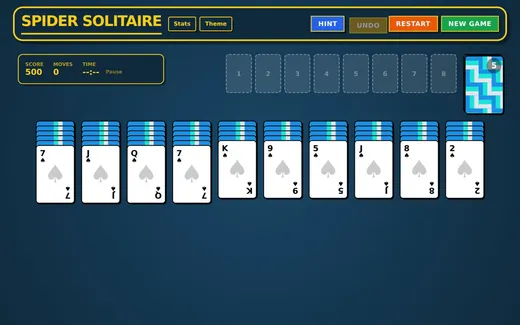
For one player, the easy card games hub holds Klondike Solitaire, with draw 1 or draw 3, undo and hints, and Spider Solitaire, where you build eight runs from King to Ace. Matching Pairs is a memory game with three boards and a clock.
For two players, the 2 player games unblocked hub is where to look. Connect 4 has a local 2-player mode, Checkers lets you share one screen, and Master Chess lets you play the computer or other players online. None of these is a card game, but they give you the same one-on-one feeling.
Looking for more ideas for a quiet moment? The games to play when bored page has a broader list.
Questions players ask
What are the best 2 player card games?
For a standard 52-card deck, Gin Rummy, Crazy Eights, Go Fish, Cribbage and Speed all work well with exactly two people. War needs no decisions at all, so it suits the youngest players or a very tired evening.
What are easy card games for two?
War, Go Fish and Crazy Eights are the easiest to learn. You can explain each in under a minute, and none needs a score sheet.
Which 2 player card game is the quickest?
Speed. Both players play at the same time with no turns, so a round can be over in a couple of minutes.
Do I need a special deck?
No. All six games below use a standard 52-card deck. Cribbage also uses a scoring board for keeping score, but paper and a pencil work if you do not have one.
Can I play 2 player card games online on Aizi?
Aizi's card games are mostly solo: Klondike Solitaire, Spider Solitaire and Matching Pairs. For two people, the 2 player hub has Connect 4, Checkers, Master Chess and more, all free in the browser.
Can I play with a child?
Yes. War, Go Fish and Crazy Eights suit young players, since the rules are short and a mistake costs little.